Christian Spirituality
Biblical and Historical
Background
Are there historical markers for contemplative prayer in the biblical text? In my opinion, "yes."
And there are other historical markers as well. What do I mean by "markers?"
In historical research, "markers" refer to pieces of evidence, clues, or incidents in source material. These
could signify the presence, development, or evolution of a concept over time. When dealing with abstract
concepts, like contemplative prayer it can be difficult to have direct and solid evidence.
In these instances, we look for textual and/or linguistic hints, or "markers" that point to possible evidence.
In this Section I will present the historical markers.
Class Outline/Assignments
Welcome: Welcome Notes - Student TestimoniesSection 1: Introduction to Christian Spirituality
Section 2: Biblical and Historical Background
Section 3: Hints of Spirituality thru the 5th Century
Section 4: Mystical and "Negative" Theology
Section 5: Augustine and Gregory the Great
Section 6: Francis de Sales - Spiritual Dryness
Section 7: John of the Cross - The Dark Night of the Soul
Section 8: The Silence of the Universe
Section 9: Silence as a Discipline
Section 10: To be Announced...
Section 11: To be Announced...
Section 12: To be Announced...
In this Section we will cover a more academic view of How/Why this discipline became so important in the early
Church. We will cover the "markers" for contemplative prayer in the biblical tradition and historical markers
in early Christian writings/writers. This may help to explain and illustrate how this very important aspect of
"spirituality" took hold for the first 400 years in Christian History.
This historical trajectory is NOT meant to be 100% accurate or exhaustive:
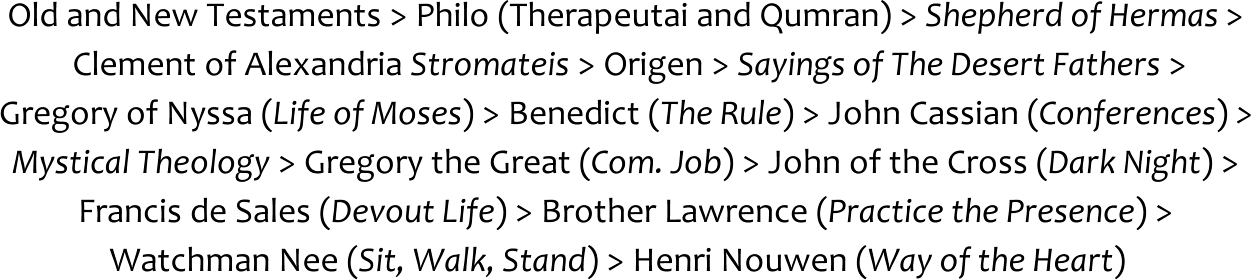
This DOES show a trajectory, but there are several other writers/writings that could be in this list: Bernard of Clairvaux, Felelon, Julian of Norwich, Teresa of Avila, Thomas a Kempis, Ignatius of Loyola, Cloud of Unknowing, just to name a few.
In this class I am using the writers I have read - these others are good - I am just not as familiar with them.
SECTION 2
Biblical and Historical Background
We have biblical texts that could be seen as "markers" for the development of contemplative prayer.
In addition, we also have extra-biblical "markers" - comments and writings in early church fathers. There is
evidence in Clement of Alexandria, but he had influences on him: the biblical text and Philo the Jewish
philosopher and Plato. Clement claims that Jesus taught certain concepts to His disciples in secret. While most
scholars do NOT believe Clement's claim, I believe Clement certainly thought this to be true. In addition, we see
a trajectory from Clement all through the history of the church. So this is the focus in this Section. Through the
remainer of the class we will take note of this trajectory mentioned above.
 2.
2.
3.
 4.
4.
There are two Lectures for this Section:
02-Biblical Historical Background for Spirituality and
03 Hints of Spirituality.
In addition, you need to read the two documents above: Excerpts from Benedict of Nursia and John Cassian.
Class Assignments:
1. Please take the time to read the texts presented from Clement of Alexandria in Lecture 02.
Clement is important because he is the first Christian writer with a special focus on prayer. Indeed Clement
reports that Jesus taught certain things to His disciples in private, and they then handed these concepts down with
care until his time. It is my opinion that contemplative prayer was part of this tradition...and Clement is
definitely the beginning of this tradition in written form.
NOTE: In several verses Clement uses the term "Gnostic" for his "spiritual man."
Clement is writing against the Gnostics and he often uses this term as a rhetorical device, basically say to the
Gnostics: "You think YOU are spiritual? The TRUE GNOSTIC [the one who "Knows"] is the spiritual Christian!
This is partly why reading the early Christian fathers is difficult - they use rhetoric and the modern reader cannot
know this unless the writer is studied similar how we study the Apostle Paul.
2. You should also read the attached excerpts from The Rule of Benedict and John Cassian's Conferences.
I have highlighted portions of the texts that we would go over in a live class. Please ponder the highlighted
portions, write/type your thoughts and/or questions. Send any "discussion" to me if you want. I can address questions
and comments along the way.
Questions, Comments or Criticisms:
You can send an email to directly to me Al Baker, CH101.
CH101 retains the right to edit and post comments/questions unless you specifically ask that your comments NOT be posted. Comments that are personal or private are never posted...only questions about Church History, the Bible, etc.
